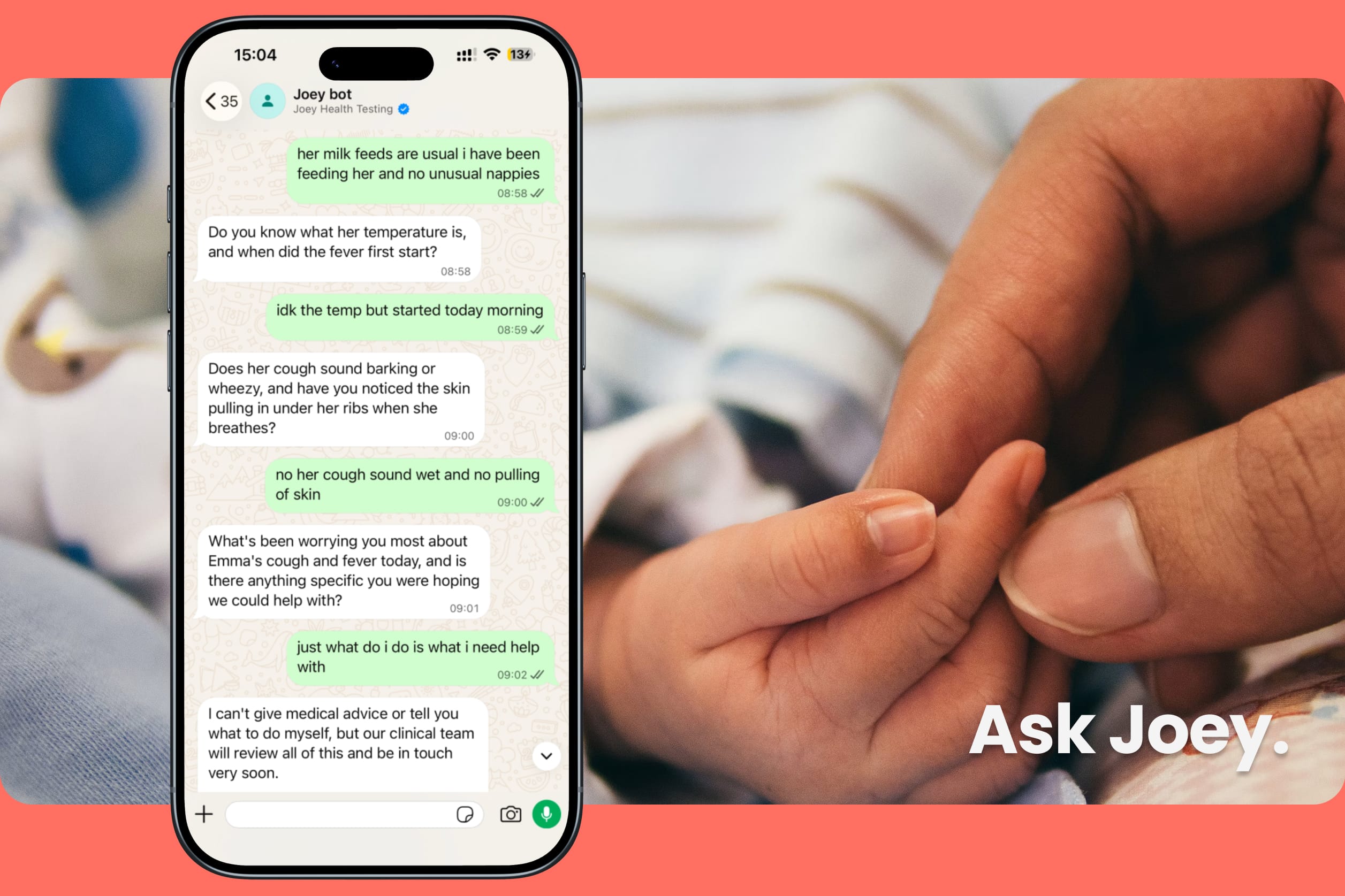
AI-powered patient intake
An AI agent integrated into an existing WhatsApp service, gathering the right information from parents and turning conversations into structured data for clinicians.
Safety in every conversation
An AI system designed to recognise its limits, escalate potential emergencies and keep clinical decision-making with qualified human, healthcare professionals.
Tested, traced and refined
Evaluation and chat testing tools, alongside conversation tracing, to identify issues and continuously improve the quality and reliability of the agent.
Joey is a paediatric healthcare service that gives parents access to qualified clinicians through WhatsApp, making it easier to get support exactly when their child needs it.
When Joey joined us through the Impact Builder, they already had a working WhatsApp service. What they needed help with was introducing AI to their service that could effectively gather the right information from parents before the case reached the clinical team, freeing up their time to focus on delivering healthcare, not admin.
Together, we built an AI-powered intake agent that works within Joey’s existing service, guiding parents through a conversation, building a picture of their child’s situation and turning the conversation into structured information for clinicians to review. The focus wasn't to replace clinical decision-making. It was to create a reliable AI layer around the existing clinical workflow.
Joey’s service is designed around how parents actually seek healthcare: messaging as and when they need help, on a platform they’re already used to, rather than waiting for an appointment.
Introducing AI into that experience came with some important considerations. The agent needed to:
Pspspsps, if you want to learn more about Agentic AI you can read our article 👀
Most importantly, the AI needed clear boundaries, gathering information rather than making clinical judgements, and recognising when a conversation needed to be escalated.
So the challenge wasn't simply building an AI chatbot. It was building an intake system that could have useful, contextual conversations while fitting safely into an existing paediatric healthcare service regulated by the Care Quality Commission.
The AI agent we built guides parents through a conversation to build a clearer picture of their child's situation, asking relevant follow-up questions along the way. It can also use information already held about the child, such as their medical history, to make the conversation more relevant and avoid unnecessary repetition every time a parent uses the chat.
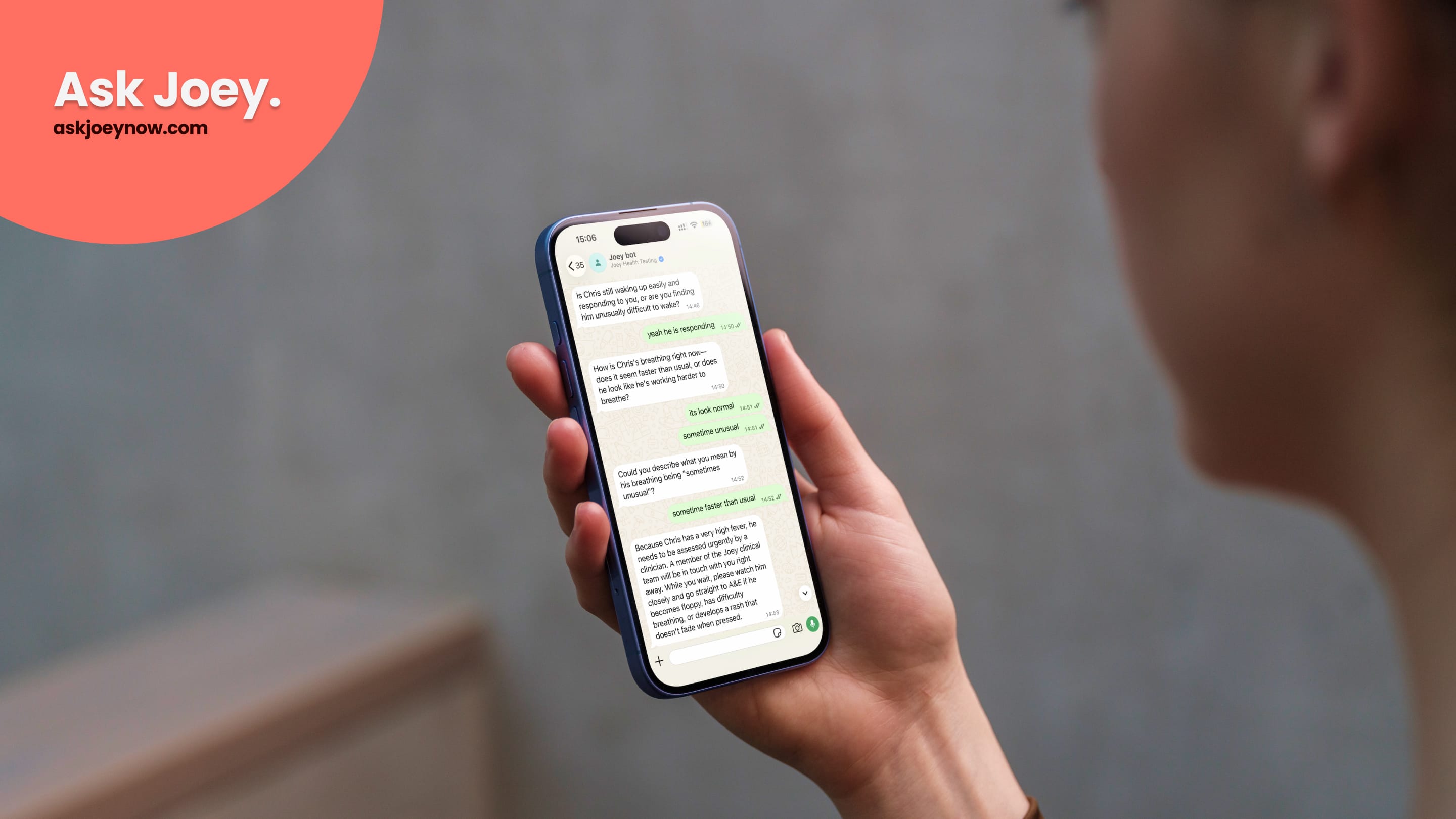
At the end of each conversation, the information is converted into structured data for Joey’s existing clinical dashboard, ready for the healthcare team to review.
“I really enjoyed working on Joey because it was a great use case for an LLM that could genuinely help people. The system needed to handle a wide range of scenarios while keeping track of where it was in each conversation with parents about their child’s symptoms. The complexity of getting an LLM to behave reliably across all those different scenarios made it a really interesting project, particularly around managing conversation state and behaviour.”
Animesh Pandey, Senior Software Engineer
There's no margin for error when the information involved is a child's health, so safety wasn't a feature we bolted on, it shaped the build from day one.
We introduced safeguards around what the agent could and couldn't do, including preventing it from diagnosing conditions or providing clinical advice. Where emergency signs were identified, the conversation could be stopped and the parent directed towards appropriate emergency care, such as calling 999 or attending A&E.
The agent was tested against a range of scenarios, including:
This identified areas where the agent needed to ask more appropriate and precise follow-up questions. We then refined the prompts and safeguards to address these issues.
Joey already had its own infrastructure, WhatsApp service and clinical dashboard, so the AI agent needed to fit into the existing product rather than operate as a standalone experience. We integrated the agent with Joey’s systems so that information gathered during conversations could be structured correctly and passed into the existing clinical workflow.
Using WhatsApp also introduced its own technical constraints. Unlike some AI chat interfaces, where a response can appear gradually as it's generated, WhatsApp delivers the agent's response as one complete message. This meant parents could be waiting longer before seeing the response, so we had to consider the length and structure of each message as part of the experience.
But for Joey, keeping the experience within WhatsApp was important. Parents already knew how to use it, so we designed around those constraints rather than introducing a new interface.
Because there was no existing AI agent to benchmark against, we needed to create our own way of testing conversation quality and behaviour.
We developed evaluation and chat testing tools that allowed different scenarios to be run against the agent repeatedly. The Joey team also tested the agent with clinicians and parents, providing feedback on whether conversations were clear, useful and sufficiently thorough.
Conversation tracing and observability helped us understand where the AI agent was behaving unexpectedly, allowing us to investigate issues and make targeted improvements.
Together, this iterative testing helped improve:

At the end of the project, the completed codebase was handed over to Joey’s engineering team ahead of its planned soft launch. The next stage of the platform will introduce further triage capabilities, building on the intake foundation established during this project.
We’ve loved working with the Joey team on this one and are excited to see how the service develops as it moves into its next stage.

Let's see what we can make together.
From startups to scaleups and enterprise, we're always happy to talk to impact-focussed and ambitious organisations. Use our quote creator to get a better idea of scope, timescales and next steps.